There Is No Cultural Self-Determination Without Safety
Protecting the conditions that allow artists, cultural organizers, and communities to build power
Nadia Elokdah
Much of arts funding is organized around familiar disciplines, institutions, programs, and funding practices: museums, theaters, dance companies, orchestras, festivals, public art, arts education, artist support, cultural preservation, and general operating support for arts organizations. These categories matter. They shape how resources move, how cultural work is recognized, and how funders understand their responsibilities to artists and organizations.
But these categories do not fully capture how culture moves through communities, especially in moments of crisis, organizing, and political pressure.
Culture also moves through informal networks, community gatherings, political education, self-published materials, mutual aid, protest, ritual, and collective memory. These practices may not always fit neatly into arts funding silos, yet they are often central to how communities build power and practice self-determination.
Recent reporting from The Guardian on the Prairieland ICE facility protests in Texas brings this tension into sharp focus. Materials such as zines, stickers, book club texts, art, and other cultural and political objects were described as part of a federal terrorism case. Whatever one’s understanding of the specific events, the story raises a broader and urgent question for arts and culture funders: What happens when the practices communities use to study, gather, publish, protest, and build power are reframed as evidence of threat?
That question brings us to a core condition for cultural self-determination: safety.
For Grantmakers in the Arts, this question is not adjacent to our mission. It is central to it. GIA’s commitment to cultural and economic self-determination depends on more than supporting artistic production. It depends on protecting the conditions that allow artists, culture bearers, cultural workers, organizers, and communities to create, gather, publish, teach, remember, protest, and build power without fear of criminalization or retaliation. Without freedom of expression, without civil liberties, and without protections for cultural and political expression, there is no real safety for artists or communities. And without safety, cultural self-determination cannot be fully exercised.
The arts field often speaks about culture as a force for belonging, healing, imagination, and democratic life. But culture does not only operate in museums, theaters, festivals, or grant-funded programs. It also lives in study groups, kitchen tables, mutual aid networks, protest songs, handmade signs, community archives, oral histories, rituals, zines, and small acts of collective publishing. These forms may not always be legible to philanthropy. Yet they are often the very practices through which communities name their conditions, protect one another, and assert the right to determine their own futures.
That is why the criminalization or distortion of cultural expression should concern the entire arts funding field. When a zine, a book club, or a piece of political art can be used to cast community knowledge as danger, the issue is not only free speech in the abstract. It is a cultural infrastructure issue. It is a narrative power issue. It is a racial, economic, and democratic justice issue.
One tactic of power is to isolate artists and cultural organizers from the communities they come from and to whom they are accountable. Another is to make community expression appear illegitimate, suspicious, or unsafe. A third is to pressure institutions to cancel, remove, restrict, or preemptively distance themselves from cultural work deemed too political, divisive, or risky. These tactics are especially harmful when directed at communities already navigating censorship, surveillance, displacement, criminalization, disinvestment, and political attack. If cultural workers are made to carry that risk alone, the field has failed to understand the real conditions of cultural work.
Arts funders have a responsibility to respond with more than concern. We must expand what counts as cultural infrastructure and invest accordingly.
Cultural infrastructure includes organizations, venues, archives, and public programs. It also includes community publishing, political education, informal gathering spaces, movement art, communications capacity, legal defense, digital and physical security, healing resources, rapid response funds, childcare, transportation, and the trusted relationships that allow cultural organizing to happen. These are not secondary supports. They are the conditions that allow cultural expression to survive pressure.
To support cultural self-determination, funders must also move beyond respectability filters. Too often, grantmaking recognizes cultural work only after it becomes institutionally legible, polished, professionalized, or safely removed from conflict. But communities do not only create culture once conditions are safe. Culture is one of the ways communities fight to become safe.
This moment asks arts and culture funders to examine whether our grantmaking practices match our stated commitments. Are we supporting only the cultural products that can be exhibited, performed, and evaluated? Or are we also resourcing the ecosystems that make self-determined cultural life possible? Are we asking artists and organizers to translate their work into institutional language before we recognize its value? Or are we willing to follow the lead of communities whose cultural strategies may be informal, emergent, contested, or under threat?
The call to the field is clear: protect the people, practices, and infrastructures that make cultural self-determination possible.
That means standing for freedom of expression and civil liberties. It means recognizing artists and cultural organizers as essential to community safety and democratic life. It means resourcing the networks around them, not just the projects they produce. It means supporting communities before, during, and after moments of public visibility or risk. And it means ensuring that tactics of intimidation, surveillance, criminalization, and narrative distortion do not succeed in weakening community power.
If culture is where communities practice freedom, then protecting the freedom to create, gather, publish, dissent, and organize is not optional. It is the work.
ABOUT THE AUTHOR
Nadia Elokdah is Grantmakers in the Arts’ Vice President & Director of Programs
ABOUT THE ARTWORK
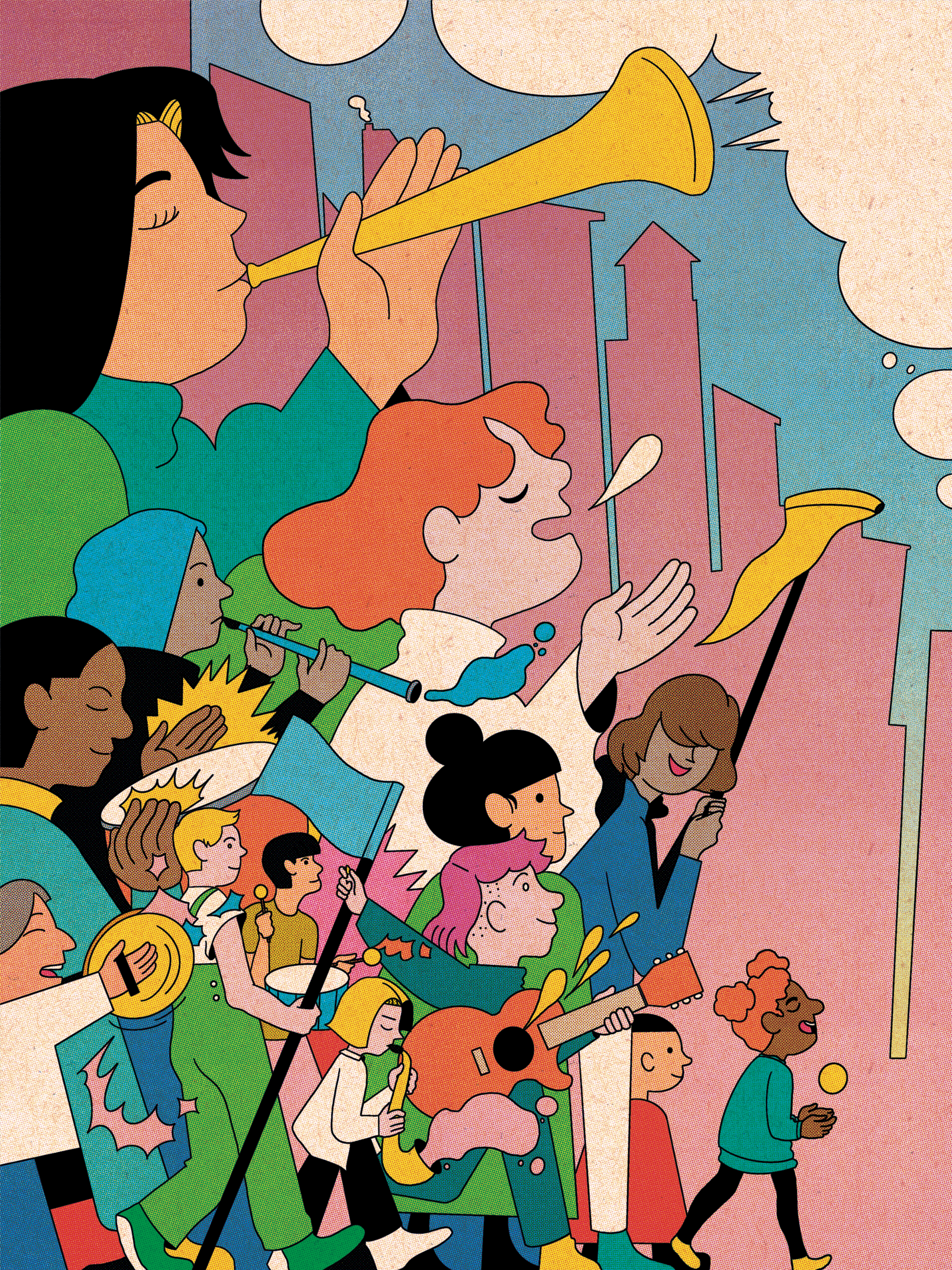
New Day Coming (2022) by Mark Wang for Fine Acts x OBI. Connect with Mark Wang online at @ouch_you_slouch and Fine Acts on Facebook: @fineacts.co, Instagram: @fineacts, or Twitter: @fine_acts.