Celebrating Innovation in the Theatre Sector
A Funder’s Reflections on the Importance of Change Capital
GeriAuriemma, Program Officer – Social Impact Theatre, The Sheri and Les Biller Family Foundation
Framing the Charge
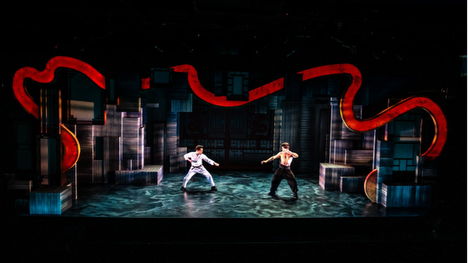
Michael Wu and Michelangelo Hyeon in Young Dragon at Seattle Children's Theatre, 2026. Photo by Truman Buffett.
Live theatre has the power to spark dialogue, shift perspectives, and inspire civic engagement. Because of theatre’s unique ability to create positive change in our communities, The Sheri and Les Biller Family Foundation is deeply invested in the health and sustainability of the American theatre ecosystem.
Coming out of the pandemic, we had many conversations with grantee partners who shared with us the challenges they face in a changing sector. Our partners believed that traditional theatre models required change. But there was neither the breathing room nor the budget margins to design, let alone implement, those changes.
Designing for Change Capital
In response, in summer 2024, the Foundation designed and launched our Change Capital Grant Program to support theatres implementing new business models or new ways of operating. Grant awardees included:
Will Geer Theatricum Botanicum: Quantifying theatre’s impacts through audience surveying
Geffen Playhouse: Repurposing a black box theatre space
Latino Theater Company: Succession planning
Portland Playhouse: Piloting social prescriptions
Seattle Children's Theatre: Partnering with Seattle Rep on a resource-sharing initiative
Portland Center Stage: Redesigning a subscription model
This new program had two goals that served as our north star:
First, we were committed to incorporating a cohort model to create meaningful channels for these theatre leaders to build relationships with one another and, subsequently, support each other in their change work.
And second, in learning alongside our grantee partners, we committed to sharing out reflections and insights with the field.
The Foundation has recently released both a collection of case studies on cohort member projects and a video featuring cohort members sharing what they are learning, discovering, navigating, and celebrating.
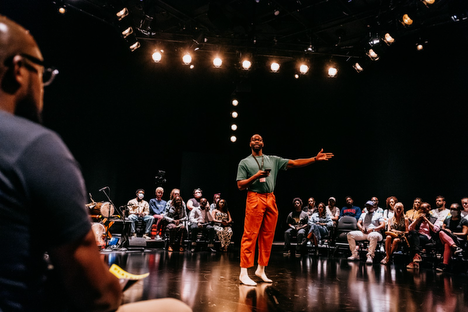
A talkback in the Audrey Skirball Kenis theatre following a production of The Brothers Size at Geffen Playhouse. Photo by Isaak Berliner.
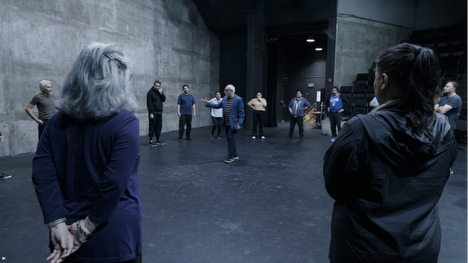
A succession workshop led by Latino Theater Company’s Artistic Director, José Luis Valenzuela. Photo courtesy of Latino Theater Company.
What We’ve Learned
Recognizing that many fellow funders are either considering or actively supporting capitalization in their own way, here are four things we learned as a funder through this program:
#1. Lower the barrier to change work — help identify shared experiences, challenges, and approaches among your grantee partners.
As we knew when designing this grant program, each theatre is working within a unique set of conditions, from budgets to audience demographics to external factors. For one cohort member, rent is $1.00 per month. For another, it is $50,000 per month. One theatre serves youth and family audiences primarily. Most others serve an older audience demographic. One theatre has a contingency plan for converting to all matinee programming in case of a city-mandated curfew. Another has weather-related contingencies in order to operate as a totally open-air space.
A change project underway at one theatre cannot simply be replicated at another and expect to yield the same results. However, funders can support conditions that foster openness and encourage candor about this kind of change work. That openness can help theatres identify common threads across projects, consider what might resonate within their own circumstances, and ultimately lower the barrier to trying a new way of operating. This was one of the advantages of the cohort model: through conversation, participants discovered more commonality across their work than they might have expected.
#2. Find abundance through the cohort model.
We are always seeking to foster relationships with and learn from our grantee partners and peer funders, so it was our instinct from the beginning to structure this grant program as a cohort. What we could not foresee were the ripple effects of a cohort that, even from its first virtual gathering, was remarkably open about their own work and excited by that of others. It was powerful to see cohort members deepen their connections and inspire new solutions and workstreams beyond the confines of the grant program itself. As one cohort member shared, the experience also challenged the protectionist mindset entrenched in the culture of American theatre.
As this program illuminated, getting a group of theatre leaders around a table, whether virtual or physical, can begin to loosen the instinct to closely guard resources. Participants connected as humans, shared openly, and began to view the cohort through a lens of abundance, with access to a collective brain trust.
#3. There is more than one way funders can approach change capital.
In developing this grant program, we felt drawn to and inspired by the concept of change capital, as described in the Nonprofit Finance Fund’s 2011 report: “an investment in an organization to: 1) support improvements in the efficiency or quality of its programs or operations, or 2) support growth, downsizing or other adjustments to the size and scope of the organization.” We recognized the necessity of this kind of funding for a sector at an inflection point. Yet, as a relatively small family foundation, we knew our funding levels could not provide the kind of substantial, multiyear investment needed to support broad organizational or operational transformation (that might more traditionally define “change capital”).
Our funding was, however, substantial relative to the Foundation’s size. And in key ways, for some cohort members it enabled them to say "now!" to a project in the planning process. For all cohort members, it represented a critical endorsement of their commitment to exploring new ways of operating. We know these one-time grants could not support the full scale or duration of the organizational change underway, and that the projects will continue well beyond the conclusion of this grant program. But they offered a meaningful way for the Foundation to respond to the needs of our grantee partners and to help make that change possible. We encourage other funders to seek out ways to support a changing sector that fit their organization’s unique set of values, capacity, and priorities.
#4. Success goes beyond line items in financial statements.
Because our grant program supported theatres changing their business models, we began with assumptions about “measures of success,” primarily centered around whether these models would increase revenue, decrease expenses, or attract new audience members. So far, each of these theatres is seeing progress in one or more of these areas. But learning alongside grantees has been a powerful reminder that there are many other markers of success. At one cohort theatre, success is a dramatically positive shift in staff morale; at another, it’s seeing new leadership activate space in a way that puts community connection front and center; and at another, it is witnessing a pilot program gain traction and considering how to build a coalition that could grow into a statewide initiative. As funders, we know success is often found beyond line items in financial statements. Supporting this cohort provided a grounding reminder to leave room for those other measures to emerge.
It has been inspiring to learn alongside theatre leaders willing to be candid about what is working, what is difficult, and what they are discovering as they test new approaches to sustainability. As a Foundation, we’ll continue to be vocal about what we are noticing, learning, and doing. We’ll continue to share learnings with other theatres exploring changes to their business model or core operations. And we’ll continue to engage our fellow funders interested in supporting that work. We hope that sharing what we are learning helps the field see experimentation not as an isolated undertaking, but as work we can learn from together. In doing so, we hope to continue contributing toward the same north star that guided this program: a more robust and sustainable theatre sector that makes communities across our country more vibrant, healthier, and dynamic places to live and create.
ABOUT THE AUTHOR
Geri Auriemma joined the Biller Family Foundation in September 2019, bringing her experience in the nonprofit performing arts and public sectors. Previously, Geri served as a legislative aide to two Seattle City Councilmembers, managing communications and constituent relations and tracking policy related to arts, education, and human services. Prior to her time at City Hall, Geri worked and volunteered as a nonprofit arts fundraiser at organizations including Pacific Northwest Ballet, Northwest Girlchoir, and the Waterville Opera House.
Geri holds an MFA in Arts Leadership from Seattle University and a BA in Vocal Performance from Colby College. She feels passionately about the fundamental role performing arts play in our communities and is honored to support the Biller Family Foundation in its work to change people’s lives in meaningful and lasting ways as the Program Officer for Social Impact Theatre.