Michael Rohd (Co-Lab for Civic Imagination)
Episode 1
How can the arts help communities imagine and cultivate health and well-being? In this episode, Michael Rohd brings perspectives from the Co-Lab for Civic Imagination at the University of Montana and his work in frontier communities. The conversation explores the connections between creative practice, civic imagination, and community life.
Jaime Sharp:
Hello, and welcome to a podcast by Grantmakers in the Arts. My name is Jaime Sharp, and I'm the senior program manager here at GIA. In honor of November's Arts and Health Month, GIA brings together experts from across the field to explore how the arts contribute to healthier, more connected communities. Throughout the series, guests consider the arts role in wellbeing, environmental health, cultural organizing, and policymaking. Listen to the episodes in this series for shared ideas and experiences on how creative work can support community life. How can the arts help communities imagine and cultivate health and wellbeing? In the first episode of this series, Michael Rohd brings perspectives from the Co-Lab for Civic Imagination at the University of Montana and his work in frontier communities. The conversation explores the connections between creative practice, civic imagination, and community life. I hope you enjoy it. All right. Hello. Hello, everyone. We're here today with Michael. I am going to let him introduce himself.
Michael Rohd:
Thanks, Jaime. It's really nice to be here talking to you. My name is Michael Rohd. The pronouns I use are he/him/his. And I'm a theater maker and have worked and lived around the US. And have worked as a director, writer, led a theater company, Sojourn Theatre for about 23 years. And right now, lead the Co-Lab for Civic Imagination at the University of Montana.
Jaime Sharp:
Awesome. And can you tell us a little bit more about the Co-Lab?
Michael Rohd:
Yeah. I mean, the Co-Lab is basically after a bunch of years of working at the intersection of the arts and other sectors. Public health, education, criminal justice, housing, and others. I was really looking for a way to have one space from which I could make the proposal in different fields that is something a lot of us know. The arts and artists contribute to public and community life in ways beyond the output that they produce. They contribute through their collaborations, through their process work, through the ways they show up as problem solvers and co-designers and imaginers and conveners. And at this particular point, they show up because they're some of the best stewards of trust and the building of trust that our communities have, particularly between local government and residents and institutions and their stakeholders. So, I started the Co-Lab because I wanted to build projects that take that premise out into the world.
I wanted to connect it with the university where students would have the opportunity to engage with that. But honestly, a lot of the work of the Co-Lab is outwards focused and happening around the state of Montana and around the United States. So, the Co-Lab is a space building models, teaching, writing, sharing research, and convening folks from across fields, both on projects and also for conversations.
Jaime Sharp:
Awesome. And seeing as it's in Montana, do you find maybe a shift from work you've done elsewhere being in a more rural community?
Michael Rohd:
Yeah. I mean, I'm definitely someone who grew up in a city and has mostly lived in big cities, but I have for my whole adult life sometimes been a working artist in rural spaces, invited into those spaces. This is definitely the first time I've lived in a state that was so rural and actually frontier as well as rural. And because of the particular project state of mind that I've been working on for the last four years, I've now done residency work in 41 rural communities around the State of Montana and tribal communities. So, it has certainly invited me to think about how the practices that I've been building for a long time relate, adapt, translate, and the ones that stay consistent and iterate, just because they're iterating creatively, but still make sense in their basic elements. And the work I've been doing is about public health and behavioral health, and that's been an amazing way to understand a state this large. You live in Chicago. How many people live in Chicago right now? Five million, six million?
Jaime Sharp:
Yeah, three. I don't know actually. A lot.
Michael Rohd:
So, Montana, which is way bigger than Illinois, the State of Montana has 1.2 million people in the entire state.
Jaime Sharp:
Wow. Yeah.
Michael Rohd:
And it also has an incredible scarcity of resources, from financial to medical and health to food. And so, it's really amazing to work in a place that's beautiful, with amazing people, and also has incredible strengths, cultural and civic, and also has a lot of challenges. And so, to build a project that operates in rural contexts and learns from people and listens to people and collaborates with people has been a really incredible experience.
Jaime Sharp:
Yeah. And so, when you talk about art practices, what are the common things that you're seeing? Is it more like performance art related? Is it visual arts? What are you seeing come out of some of these projects that you're doing? And if you could give maybe a specific example of what a project looks like, like from its inception, how do folks get involved? Is this something you're finding the people and bringing them in? Do they apply to be a part of this?
Michael Rohd:
So, the big project I've been working on for four years is called State of Mind. And it's a touring theater and public dialogue project that takes workshops with young people and adults, and an original show, and town hall meetings to communities for a period of days. So, that's what we've been touring now for over two years, and that's the project that has been to 41 communities and is on the road. We just finished somewhere last night. We will be somewhere in a week and a half. And we're also now doing return visits. So, our initial visits are a couple days. And we work with the community for six to nine months to build those relationships and prepare. And we're working with public health departments, health providers, local elected leadership, schools and educational districts and community organizations and nonprofits. So, we spend half a year to nine months building coalitions of those stakeholders before we arrive, and then we arrive and work across those stakeholders and with young people.
So, it's theater-based, although in some communities we've now been bringing visual artists with us and also having exhibition and installation elements as well that are created with young people in community. And I guess the short version of explaining the project is when we got here to Montana, I wanted to figure out what a good first project would be and I wanted to find out what was needed. What was the state needing to have conversations about that I felt like as an artist maybe I could contribute to and that other artists could contribute to? So, I did a listening tour and discovered that one of the most nonpartisan issues in the state that was urgent was behavioral and mental health, that it's a crisis in Montana, like a lot of places. But Montana has the worst statistics in the US, like top two states around suicidality, addiction, depression, and then the scarcity of health providers and mental health resources on the other side of that really low.
And whoever you talk to, Republican, Democrat, independent, green, libertarian, everyone agrees that it's a crisis. They don't all agree on what needs to be done about it, but it's not hard to start a conversation with someone about it, which made me feel like this is a good thing to learn about and figure out if as artists we can contribute to the conversations around the state in meaningful ways. So, I think I'm going the long route, so you can tell me if I'm off track. But what we decided to do was build a circle of stakeholders from around the state who work in health and education and who also have lived experience around these issues. And they helped us come up with a set of goals, goals like reduce stigma, make resources more legible, center youth voices and activate them, listen around the state and take those conversations into other spaces where resources might listen and learn and then support, and also normalize non-traditional care strategies.
So, we then built a project. We designed the workshops. We designed the touring model. Built an original devised participatory show all to serve those goals. And now, the Co-Lab basically has been leading this State of Mind program around the state for the last several years and we're having a tremendous impact community by community. And we're sort of being integrated into the public health ecosystem of Montana and into the educational ecosystem of Montana. And that's been both an amazing learning journey, but it's also making the case everywhere we go that artists, in addition to what they create and show, contribute in ways that are surprising in many places. We convene and host local conversations that are not happening without us sometimes. We help build coalitions across sectors that were not connected before our work with that community. We help host a conversation between young people and families and adults that is a really hard conversation to have, and we're using theater to make a space for that.
So, there is an arts and health movement around the country. You're talking to people who are leading that in different ways. We're practitioners. There's research coming out of it. We're generating data in every community that goes to the state legislature, and goes to funders, and is actually helping direct some resource allocation in communities to help support their needs. But as artists, we're using the power of convening, problem solving, co-design and engagement to bring folks together in unique and creative ways. And it's a team of artists. So, I've hired actors, creators, designers. And the team that goes out on the tour is three performer facilitators, a lead facilitator who is often me, and a counselor, social worker, because we always need a mental health expert everywhere we go. And that team's expanding a little bit, because as we get invited to go back to communities, we're doing longer residencies, we're building original shows.
I think we're staging a piece in a swimming pool this winter in a wellness center that's being opened in a town in Central Montana, based on an assortment of interviews we're going to do over a period of weeks. And then as a way to bring people together for some of those conversations, we're creating a spectacle and public dialogue in this new wellness center. So, we're working in lots of different ways, but theater is central to it and listening is central to it. And if you get interested and I can tell you more about the work we're doing with young people that's very central to this, but I'll pause there.
Jaime Sharp:
Yeah. Well, firstly, I would love to hear that, but I'm also just curious because you talked about data that is going to the state legislature and funders. How are you measuring impact and the contributions that artists are making to make this case for them in order to garner that support?
Michael Rohd:
So, we're not doing that. We're not sending them data to garner support for the arts. My belief is that it is counterproductive to go out and say the arts are important, support the arts. Although I believe that, I don't spend my energy on that. I spend my energy on demonstrating how artists contribute to value and community outcomes that communities are already working towards. So, if I go into a rural town of 1,200 people, what they will not say is we really want and need more arts and culture. Now they might, and they might say, we need more cultural activity for our young people, but they have stressors that include things I talked about. Scarcity of resources, food insecurity. What they are looking for are creative ways to problem solve and bring people together. So, we go in and do that, which results in the value of the arts becoming clearer in that place and ultimately around the state.
But the data that we're sending is not data about what the arts can do. The data we're sending is what the communities have told us about their needs in relation to health and mental and public health. Because what's become clear is, and maybe this is strange, it's been really interesting to figure this out, we now have more on the ground experience listening to residents in this state about public and behavioral health than any other entity in the state. Because no one else is on the ground in all these places, asking these questions, listening to young people, bringing adults together. The data we're providing to the state is actual grassroots first person voices about needs and aspirations and visions. And we're moving that into legislative policy spaces.
We're moving that into philanthropic spaces. And really importantly, we're moving it into department of public health and human services spaces that's then leading to committees and groups hearing that and having that information, which is different than a policy paper, different than statistics that come from phone surveys or extrapolation from mathematics. We're actually bringing voices, themes, and direct statements. And our first year, we felt like people were receiving it. As we got into our second year, people actually started integrating it into school board meetings, legislative committee meetings, county coalition meetings. And now there's a whole process going on where there's a funding collaborative that's using that data to decide how to support communities around the state based on what they're hearing that they need.
That's become part of the process. So, the data is about community needs, not about making the case for the importance or value of the arts. And to tell you the truth, Jaime, it's really interesting to talk to you at GIA, because almost all the money that I've raised for this, none of it is arts money. I was unable to raise a penny from art sources for this project because they wouldn't believe in it on the front end, I guess. Didn't consider the rural nature of it or the intervention, something they wanted to fund. All the money has come from health foundations. So, it's me persuading folks in the health field that this is a meaningful intervention and then the arts can be useful.
Now the work of folks like at Neuroarts and University of Florida College of Arts and Medicine and others, that helps me make the case, but it's also just persuading them that this is going to be a way at these goals that communities aren't trying. And we got a little bit from some stakeholders at the beginning. And then once we started to have impact, those health foundations doubled and tripled down, which has allowed us to keep the work going, but no arts money. So, that's been an interesting part of the journey.
Jaime Sharp:
Yeah, that's super interesting. I think I do have a follow-up about that, but I wanted to pause and go back because you wanted to talk a little bit about your youth programming.
Michael Rohd:
Yeah, sure. Yeah. So, when we arrive in a community, one of the relationships we build for months and months beforehand is with the high school. And the first activity we do on day one of our residency is a 90 minute to two hour workshop with 10 to 30 high school students. And I should say in some communities, that's the whole high school. In some places, 32 students is the high school if you're in a town of 961 and there's some folks coming in from the frontier area around it. So, that's kind of amazing when you get to work with all the high school aged students in a place and get that experience with them. And then in some places there's 170 people in the high school and you work with 30 kids. In that workshop, it's basically a listening session and it culminates in the students writing with us.
They write a text that we call care commitments, and they basically follow this idea. We say to them, here's the initial prompt. We the young people of this community, in order to feel welcome, healthy, and safe, need the following conditions to be met. And then there's a set of statements. We need to know blank. We need to believe blank. We need to never worry blank. There's 10 of those. And we spend 30 minutes with them writing them and then us bringing them to get small groups and then a whole group. And we end up with this pretty beautiful document. And that document immediately goes in the show that night. It becomes part of the show. So, in every town, youth voices are part of the text. Even more importantly though, in the middle of the day, we do a workshop with all of their teachers and public health officials and health providers, and the curriculum of that workshop is the words of their young people.
And so, what their young people say they need and want to see from their adult community, we then spend a couple hours with the adults in their community processing that, reflecting on it, thinking about action steps, identifying gaps, talking about existing assets, talking about needs, resources. Those are really often very powerful conversations. And then it appears in the show that night. And then the next morning at the town hall meeting, that text from the young people comes back and is a part of the structure of that as well. So, we sort of say that youth voices and youth visions become a central part of our time in a community. And those care commitments from the very beginning have been used. We didn't even realize it, but the third community we went to, they took it to the school board the next night and used it to advocate for more resources.
In another place we went a couple weeks later, they took it to a public health coalition meeting. And used it again to say that what the public health coalition and the department was working on was off base from what young people said they needed. And they used it to intervene and make a conversation about what young people actually said they wanted and needed. So, it's been really interesting to see that text move through communities and across the state.
Jaime Sharp:
Wow. Yeah, that's really incredible to hear. And I'm so glad that you're making room for the kids to speak. I think we so often don't take younger voices seriously enough and they know so much. They know so much.
Michael Rohd:
Yeah. And they will speak to things that adults will sometimes not speak to until it is brought up to them or insisted upon. And so, I mean, some very intense things come out of those youth workshops that are sometimes hard for adults to hear. And that's been really just powerful to get to be a part of.
Jaime Sharp:
Yeah. And so, our central question today was what is the role of the arts in community health and wellbeing, which I feel like you have addressed in several of your responses, but now I'm curious if I can adapt that question. What is the role then of arts funders in community health and wellbeing? I was very surprised to hear that your support has been coming from health foundations. How can we change that, other than I guess maybe the obvious? Folks, arts funders can move money to initiatives like yours. But I mean, how can they help beyond just the monetary, maybe from a relationship building standpoint, from their own relationships with artists and grantees and their communities? What could this look like if they even wanted to start their own initiative or support the start of an initiative like this in another place?
Michael Rohd:
Yeah. I really appreciate that question. It's a great question. I won't presume to know what conversations people are having at GIA. I know some people there, but I haven't been in a long time. But I can tell you a soapbox I was on last week at a national conversation about the future of the nonprofit regional theater in America. And a bunch of us were invited to speak to what's happening with institutions. And my soapbox is I think similar, but again, this might be very present already as a thread at GIA. I think folks in the arts, artists, institutions, funders, local arts agencies, when trying to make sure that the arts have support and are valued, often make those conversations insular and feel that we need to find solutions and messages from the inside, and then move outside and convince people that the arts have value.
And the truth is where we are at as a country, facing rising authoritarianism, facing the dangers of super intelligence, and in particular facing eroding trust between individuals and communities and between institutions and communities, we do not need energy spent within any sector singly alone to save itself. We need sectors working across sectors to, I'm not going to use the word save, to nourish and support our communities and what they say they need. We need civic health, which is about trust. The arts are an important player in the building of civic health, but they are not that alone and they are not that without being in collaboration and dialogue with other sectors in their community. So, arts funders need to be working with funders in other sectors around the conversation, not about how can we support the arts, but how do the arts help make healthier communities, healthier from a civic place, not just a behavioral and population biological health level?
Because we do not have healthy individuals and healthy populations if we do not have trust in communities, because policies don't serve individuals, people don't trust the institutions that supposedly serve them, and therefore don't get what they need. We need trust as much as we need... Trust is medicine. Relationships are medicine. And so, arts funders can be trying to figure out how do we, through our resources, through our interventions and visions and opportunities, steer artists with support towards opportunities to work across sector and work on civic health. To me, the idea of civic imagination is how we do that, which is when artists work with others in community to build a capacity for a community to imagine together an equitable future for all. And arts funders can contribute to that by, again, building pathways for those collaborations.
And when they see artists and arts organizations seeking to work on public good and not just saying public good is my artistic creation, but public good is how my art is connected to the people in my place and what they say they need and how life is being lived here. When arts funders support artists doing that and make space for that and convince other funders to support that, then they're really helping us build towards community health and not just a more valued arts ecosystem. We don't need a more valued arts ecosystem, unless we also have a more valued human ecosystem and communities that are healthy and vital.
Jaime Sharp:
Yeah. Wow. That's such an incredible reframing. Even now I'm like, the gears are going for me as thinking on my work as an artist as well. So, I really, really appreciate you bringing that here. Michael, thank you so much for your time. I just want to ask before we conclude, is there anything else you'd like to share? How can we learn more about Co-Lab and follow your future work?
Michael Rohd:
That's so nice of you, Jaime, and thanks for inviting me. It is a really important audience, not just arts funders, but folks who follow along with all the amazing learning. I mean, you all at GIA publish a lot of good stuff, so it's nice to be in that conversation and for folks to have access to it. So, thank you. Yeah, I mean, folks can Google. I think the easiest thing to say is Google my name, Michael Rohd, R-O-H-D, and Civic Imagination and you'll get to the Co-Lab. Or Google Civic Imagination State of Mind and you'll get to the videos and the information. There's ways you can learn there. Reach out. The one thing I didn't say is it's becoming a national initiative. I did a national institute at Georgetown University this past summer in D.C.
People from 13 states came to learn the sSate of Mind model, and they're working on it in different states, building versions. Rural Vermont, Tennessee, Colorado, Baltimore, Maryland. So, another way people could get involved is I'm trying to raise resources to help support those projects at the local level so they have a way to do that work. So, folks can think about that as well. How do we seed models and connections across the country?
Jaime Sharp:
Thank you so much for listening to this episode of the GIA Podcast. To explore more episodes in our Arts and Health series, please visit giarts.reader.org. I hope to catch you next time.
ABOUT THE SPEAKER
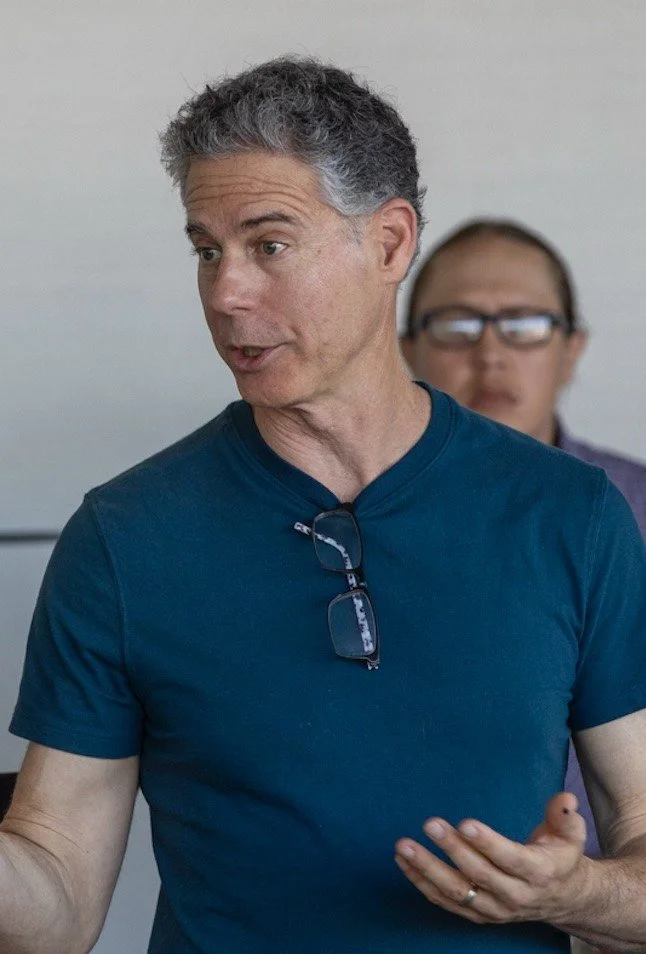
Michael Rohd, a theatre maker, educator & facilitator, has been working at the intersection of culture, community development, local government and public health for over 30 years.