Become an Accomplice: Lessons for Funding a Resilient Future
Mandy Van Deven and Candice Wynter
It’s common for people in the philanthropic sector to refer to narrative and cultural strategies as work that’s “new” or “emerging,” but in reality these approaches have a long and rich history of igniting new ideas, coalescing people around them, and transforming societies. All around the world for millennia, artists, musicians, and storytellers of all kinds have successfully leveraged their passion, their intellect, and their creative capacities to push back, to inspire, to imagine, and to practice more desirable futures. This work happened before the advent of recorded memory, and has consistently evolved with the introduction of new technologies. Most often, it takes place through prosaic practices of knowledge sharing, meaning making, and community building that include things like ritual, foodways, and oral traditions.
In the introduction to The Sum of Us: What Racism Costs Everyone and How We Can Prosper Together, economic policy advocate Heather McGhee wrote: "Everything we know comes from a story we are told.” This simple yet powerful statement conveys a truth we often forget, which is that what we believe, how we behave, and what we see as possible doesn't come from nowhere. It comes from the choice that someone else made to tell us a story that reflects their reality, or what they want their reality to be. So, the questions that narrative and cultural strategists raise about whose imaginations have dreamed up the stories that make up our reality today and the choices we need to make now if we want tomorrow to be different are imbued with the rigor of ancient wisdom about how change is truly made — because it’s never not been made that way.
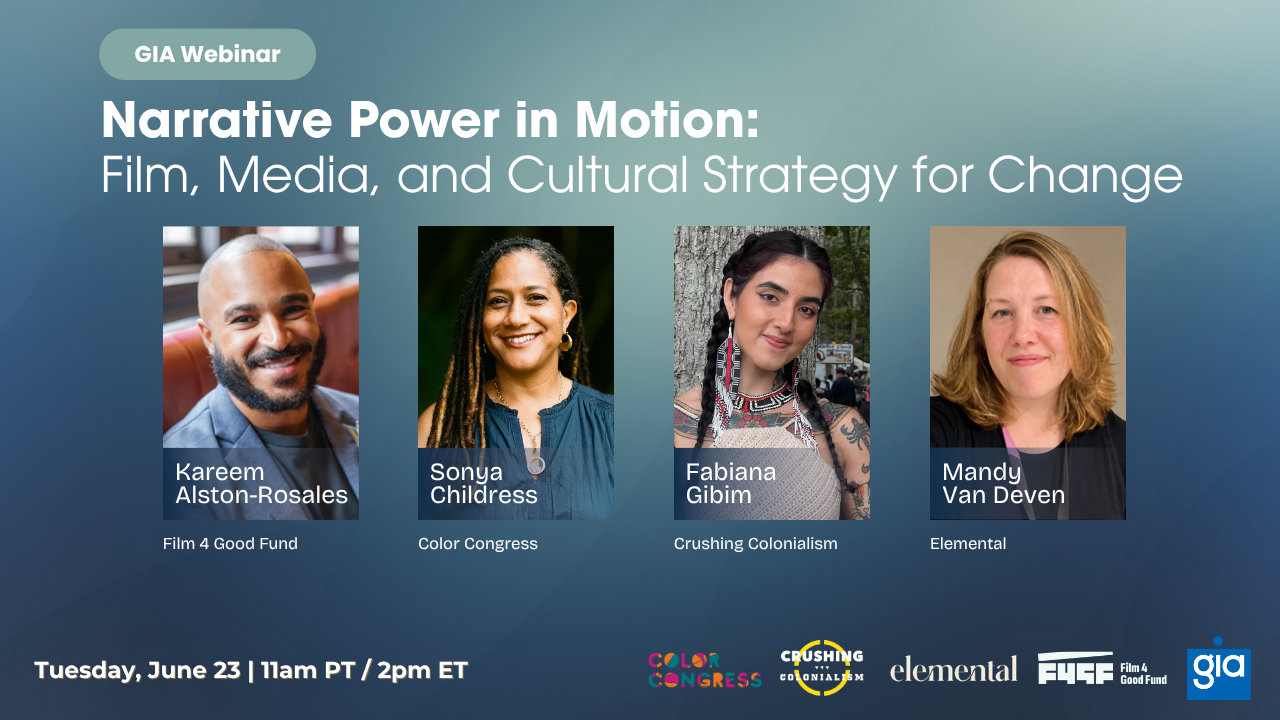
Earlier this year, Mandy Van Deven (Elemental) moderated a conversation with leading narrative and cultural strategists Sonya Childress (Color Congress), Fabiana Gibim (Crushing Colonialism), and Kareem Alston-Rosales (Film 4 Good Fund) about our collective power to reshape the narratives that got us here and to build a culture that reflects our desires, demands, and dreams. Funding durable change at scale requires more than resourcing individual stories, and when philanthropy understands ourselves as part of a lineage of dreamers, we can build on groundwork that has already been laid, and leverage the abundance of those resources we've inherited alongside the financial assets we have the power to allocate.
The following has been edited for length, but the full recording can be accessed here.
How did you come to work on film and media, and why is it important for building narrative power?
Sonya Childress: I've spent close to three decades working in the documentary film sector as an impact producer, which is the person who is tasked with maximizing the reach and social and political impact of a documentary film. Impact production is premised on the notion that documentary films are uniquely powerful because they sit at the intersection of art, storytelling, and journalism. They are trusted sources of information by a range of viewers and audiences, and they're historically powerful vehicles for personal storytelling, community storytelling, and advocacy.
My current role, though, is as the co-founder of Color Congress, which is an ecosystem builder and an intermediary that supports people of color-led documentary organizations across the United States and the US Islands to bring their films to diverse audiences. Our belief is that by supporting the organizations that are accountable to social movements and to specific identity communities, we can build a larger ecosystem that understands the political power of documentary filmmaking and contribute to narrative change in conversation with grassroots organizing, political advocacy, and other cultural forms.
Kareem Alston-Rosales: I was a documentary filmmaker in high school, and when I went to Stanford, I got a grant to do a project on hip-hop and narrative change around the anti-apartheid struggle in Cape Town, South Africa. For the last six years, I've been working in philanthropy to gather folks around narrative change, which put me in a position to go to Sundance. Filmmaking is beautiful, but it's not gonna be one organization or one film that will change things. We all have to work together to bring the resources that filmmakers need. The strength of the ecosystem is what's most important.
Fabiana Gibim: I'm an Assyrian and Guarani-Kaiowa Indigenous artist, researcher, and editor from the border of Brazil and Paraguay. My work develops the concept of night, darkness, and sound as instruments of fugitive knowledge in Black and Indigenous media practice. It’s based on an understanding that the crisis we are living through is not, at its root, a content or media crisis, but a cosmological crisis. We do not lack stories about what is wrong. We lack the narrative infrastructure that allows different worlds to feel possible, thinkable, or worth building towards.
Crushing Colonialism is an international organization that supports Indigenous artists and media practitioners across the so-called United States that have been working under conditions of narrative suppression for centuries. We have survived that suppression and are still here, still storytelling, and still building the worlds that the dominant culture repeatedly declares impossible. This technical expertise is what I want to bring into the conversation today.
What does narrative power building look like for the ecosystem you're working within?
Fabiana: I’m going to start by naming the confusion that causes a lot of clash in the sector. The word ‘narrative’ has been flattened to mean a particular story or a message that is crafted to shift public perception on a specific issue. This is a communications model that is radically incomplete, and treats narrative as a tool that you produce, deploy, and measure that operates on the world from outside. But narrative is not a tool; it is a condition. It is a living system that determines what a society can think, what it can feel, what futures it can conceive of, and who those futures apply to.
The dominant model of narrative change does not operate from the understanding that narrative is not in service of the world, but a constituent part of it. At Crushing Colonialism, we are not a media organization in the traditional sense of producing content, distributing it through existing channels, and measuring impact in metrics. We are an ecology of Indigenous storytellers who understand our work as worldmaking, and this distinction matters. We're not trying to build a counter narrative to the dominance narrative or trying to be marginal. We work on the level of infrastructure and building the relational networks, knowledge transmission systems, and archival practices that allow Indigenous storytelling to function as what it is and what has been for centuries: a technology of civilization resilience.
Sonya: There are frontline storytellers who are not making films for Sundance or Hulu. They are making films for their communities because they understand that authoring your own experience and sharing that with your own community is a liberatory process. And it's liberatory not just for the person holding the camera, but for the people on screen, the community members who are participating in that process, and the audience experiencing it. Documentary film works on an intellectual level to open our minds, but it also opens our hearts in a way that operates on a spiritual level. For us to value that as a commodity that gets judged by the marketplace is really to underestimate the power of what we're talking about here. It's not just in the final product. The process is also the product.
At the end of the day, Color Congress is a solidarity project. Success is getting the leaders of these organizations and the filmmakers they support to see one another as collaborators, not competitors for philanthropic support. It doesn't matter if I supported that filmmaker, I'll show their film to my community because your story is my story. As we move collectively, we’re building a multiracial, pluralistic democracy at the grassroots level, one story, one organization, one artist, and one community at a time. It's a kind of mycelium beneath the surface.
For those who are new to filmmaking, give us a sense of the labor that’s involved and how much it costs to produce a film.
Kareem: Filmmaking can be broken down into three phases, and if you break it down into pieces, every funder can play a role in the process. The first phase is development, which involves creating the blueprint: writing scripts, hiring story editors, optioning the rights. That's roughly $100,000, and there are many in our sector that fund this work, like Sundance Institute and Mellon Foundation. This makes the difference between a story getting told or never getting off the ground.
The middle phase is production, which is what most people think of as making a movie: cast, crew, equipment, locations, feeding everybody on set. For an indie film like Moonlight, that’s around $900,000. This is where the big, institutional funders and investors come in like Netflix’s Fund for Creative Equity and Doris Duke Foundation.
The last phase, finishing, becomes the hardest. Once you've invested that much time and money, you really wanna finish it, and you still have to do the editing, sound mixing, color grading, music licensing, and reformatting for festivals or streamers. This can cost up to $500,000 for an indie film. Underrepresented directors, and people that don’t come from money, often find themselves at the finish line with no resources left. Documentary filmmakers have organizations like Chicken & Egg Pictures, JustFilms at Ford Foundation, and Firelight Media that carry films all the way. We need the same for scripted films.
Then once a film is made, the distribution process begins. Can you talk about how your work is addressing the distribution challenges we often hear about?
Sonya: We have a field-building fund of $300,000 that our members can direct towards their collective needs or ambitions. We do this through a months-long, consent-based deliberation process. Two years ago, our members identified distribution as a primary challenge, and considered a lot of different avenues to address the distribution crisis. They knew there were a lot of projects to build new streaming platforms, and considered that as an intervention, but honed in on the fact that this is not a problem of a lack of screens, but getting audiences to those films.
They decided to intervene in the issue of distribution through marketing, and directed two years of the field-building fund towards a series of eight marketing experiments over a year and a half to test various ways of directing attention to documentary films and bring those films to audiences of color. We hired strategists of color to test lots of different theories. We worked with content creators on TikTok and Instagram to bring young audiences to youth-directed documentary films. We did a retrospective of beloved filmmakers of color whose work has supported movements and communities for decades, but whose name recognition was low. We brought back and restored a beloved documentary film that we believed could be brought back into the cultural zeitgeist.
All of these experiments taught us that there are deep audiences within communities of color for nonfiction films that reflect our experiences, our contributions, and the complexity of our lived experiences. We also learned that there's an incredible amount of censorship that happens on social media platforms right now. The marketing of documentaries about people of color is considered “political content” and was censored over and over again on TikTok and Instagram. The ways we confront algorithmic censorship and bring films into communities without doing a ton of promotion on channels where those communities are being surveilled is going to be a really important strategy and a skillset we all have to learn. This is going to reshape our relationship to audiences and our relationship to distribution moving forward.
The erosion of public funding for film, art, and media is being acutely felt right now. If we're going to find a silver lining in this moment, what opportunity does it create for us to vision forward and build into that vision?
Sonya: The closing of the Corporation for Public Broadcasting essentially eliminated federal funding for independent documentaries, which is one of the few art forms in the United States that is largely funded by federal funds first — before commercial money comes in, before philanthropic money comes in. What that means is that it will limit the kinds of documentary films that are made and seen in the United States. If we leave documentaries to the commercial sector, or to the current administration, we will see more true crime, more celebrity exposés, and more propaganda films like Melania.
On the right of the political spectrum, there's a clear understanding of the role of cultural products that carry messages that move their base towards the future they hope to realize. They've made long-term investments in a range of artists and a range of cultural work that is not burdened by overly prescriptive impact measurements and unrealistic timelines for outcomes. They are doing trust-based, flexible, and long-term investments in cultural strategy work and in narrative infrastructure, and if pro-democracy funders believe that we understand and value the role that culture plays in social change, then we have to fund at that level as well.
One thing that means not requiring a film to have quantitative impact in a 12-month grant cycle when that film is trying to address an endemic social issue. Ava DuVernay did not fix mass incarceration with 13th, and Al Gore did not fix climate change with An Inconvenient Truth, but they gave communities a lexicon and connected the dots between issues. They gave us a framework for understanding a problem we were seeing, but couldn't name, and they helped us envision a path forward to a more just future. We have to make long-term investments in multiple films that address issues from multiple entry points that speak to multiple audiences, not discreet ones. That is the future.
Fabiana: The closure of federal funding for public media, the retreat of commercial platforms from documentary, and the pulling back of philanthropic investment in race-based organizing is being experienced as a crisis, but it's not a crisis for everyone equally. This asymmetry is important because some of us have been operating in a permanent state of scarcity. For Indigenous and Black media makers, we did not get the Corporation for Public Broadcasting funding or Netflix deals. We have been building and maintaining community-controlled media infrastructure — radio stations, oral history archives, community publishing networks, language transmission programs, and everything else — without the resources of philanthropy and corporate production companies.
What this means is that we have something that is now desperately needed, which is the practice of building infrastructures that do not depend on institutional permission to exist and that does not crumble because it is embedded within living relationships. Living relationships are the only thing that survives the collapse of any funding source or single institution. So, the opportunity in this moment is not to rebuild what we’ve seen collapse so easily, but to learn from the infrastructures that didn't crumble and to invest in us as the model for what comes next — not just as the promotion of underrepresented voices, but as a model of collective ownership and governance infrastructure that the ecosystem now needs. We are not the beneficiaries of this transition, but the architects of it.
Many who work in philanthropy do so in accordance with a purpose that goes beyond their institutional mandate. Every grantmaker has the opportunity to not just fund transformative work, but to be an accomplice in it. What does it look like for a funder to be an accomplice?
Sonya: Whatever role we're playing in this ecosystem of change, we all have positional power that we can leverage to the fullest. In this moment when philanthropy is under increasing scrutiny, some are doing their best to protect grantees and others are protecting their endowments. I would invite folks to not simply uphold the reputation of their institution, but think about: what is your personal legacy? Who are we here to serve? What is the greatest work that we can do with these resources?
Sometimes it's being a person that challenges from within an institution and advocates to do and give more and in flexible and trust-based ways. Sometimes it's asking the general counsel what the line is that cannot be crossed and starting your work there. If we believe we are working towards a just future, then freeing those resources is the work of every person in philanthropy right now.
Kareem: Being an accomplice means finding a creative way to plug in, even if it's not obvious. I know there are limitations to whatever your portfolio is, but trust that if you reach out to any one of us, we'll find a way to fit you into this ecosystem. There are ways to be proactive about building that future vision. Let's be creative together and find a solution.
Fabiana: Everyone here is already implicated; the choice is if you’re going to remain a witness or you're going to become an accomplice. Being an accomplice is not just about writing a check; it’s a shift in how you understand your relationship to this work. A witness observes the crisis from a position of relative safety and responds only when it becomes undeniable for them. An accomplice understands that they are already inside of the narrowing of imagination, the exhaustion of political creativity, and the brittleness of response. You know this is not something that’s happening to other people; it's the texture of the shared world we are all living in. An accomplice would ask: what can I do with the resources I have and the position I am in?
Every time you see the repetition of these narratives about the dread of what is happening, that's our absence in the narrative domain. This is the consequence of decades of disinvestment in the oldest and most sophisticated narrative infrastructure that exists, which is Black and Indigenous storytelling technologies. These have survived five centuries of targeted destruction because this intelligence poses a genuine alternative to what we are living. So, when you fund it, you’re investing in a technology that could actually change the conditions for how everyone thinks, feels, and imagines what is possible. Use the power of your position in service of work that you may not fully understand sometimes, but can see from its resilience that it is doing something more than what your current framework can capture and that the moment we're living calls for.
Mandy: I'll leave us all with a question to reflect on: how am I making the most of the power and agency I have to be an accomplice to narrative and cultural workers, and in doing so, set a new standard for philanthropy? Because if everything we know comes from a story that we are told, then let's embrace the most audacious one and live into a better story.
ABOUT THE AUTHORS
Mandy Van Deven is the co-lead of Elemental, a funder learning and grantmaking initiative that cultivates conditions to resource narrative power, and the founder of Both/And Solutions, a global consulting collective that provides strategic advice to individual wealth holders and philanthropic institutions, facilitates organizational and field learning, and designs and implements funding initiatives that advance gender, racial, economic, and climate justice.
Candice Wynter is driven by the mission to reimagine how to resource and advance meaningful social, policy, and culture change in our lifetimes. She partners with philanthropic organizations and nonprofits on a variety of mission-driven strategic planning, communications, grantmaking, and impact investing efforts that unlock investments in solutions that help people and communities not just survive, but thrive.