Foundation Grants to Arts and Culture 2023: A One-Year Snapshot
Steven Lawrence, Independent Consultant
In 2023, giving by all active U.S. private and community foundations grew less than 2%.[1] Among the largest U.S. independent, corporate, community, and grantmaking operating foundations included in Candid’s 2023 Foundation 1000 dataset, overall giving rose 9% among a matched subset of funders. By comparison, however, arts and culture funding among this matched subset increased just 1%, suggesting that the field represented a lower priority for these foundations.
Highlights
Arts and culture funding, among this matched subset, increased just 1%, suggesting that the field represented a lower priority for these foundations.
These key findings represent Grantmakers in the Arts’ (GIA) twenty-fourth snapshot of foundation giving for arts and culture. The definition of arts and culture used for this snapshot is based on Candid’s Philanthropy Classification System and encompasses funding for the performing arts, museums, visual arts, multidisciplinary arts, humanities, historical activities, arts services, folk arts, public arts, and cultural awareness. The findings presented in this snapshot are based on an analysis of two closely related datasets. The analysis of the distribution of 2023 arts and culture giving uses the latest Foundation 1000 dataset,[2] while the analysis of changes in foundation giving for the arts between 2022 and 2023 uses a matched subset of foundations that are included in the Foundation 1000 for each of those two years.[3]
The size of the median arts grant grew.
The median arts and culture grant amount increased to $40,000 in 2023, after remaining unchanged at $35,000 between 2021 and 2022. Nonetheless, this median arts grant amount totaled markedly less than the $50,000 median overall grant amount.[4]
Large grants accounted for just over half of arts grant dollars.
Arts grants of $500,000 or more accounted for 52% of overall grant dollars for arts and culture in 2023, compared to more than 60% between 2020 and 2022.
Top arts funders accounted for a larger share of overall giving.
The top twenty-five funders by giving provided 39% of the total arts dollars in Candid’s 2023 Foundation 1000 dataset, slightly higher than the 38% share reported for 2022. The share of arts giving accounted for by the top funders has remained relatively consistent for the past decade.
Foundation funding for the arts continued to decrease as a share of total dollars in 2023.
Among funders included in Candid’s Foundation 1000 dataset, giving for arts and culture totaled $4 billion, or 6% of overall grant dollars. This was the lowest share ever reported for the Foundation 1000.
Total funding for the arts increased slightly.
Arts grant dollars increased about 1% among a matched subset of Foundation 1000 funders, compared to 9% overall growth reported by these matched funders. Despite this slower growth, the number of arts and culture grants reported by matched funders rose 2%, compared to a 1% decrease in the overall number of reported grants.
Relative to overall foundation giving, a notably larger share of arts grant dollars provided general support.
In 2023, general operating support accounted for 32% of arts and culture grant dollars. This share surpassed the 23% share of overall foundation giving that funded general operating support in that year.
Please note: It is important to keep in mind that the foundation grantmaking examined here presents only one source of arts financing. It does not examine arts support from earned income, governments, individual donors, or the business community. This analysis also looks only at foundation arts support for nonprofit organizations, and not for individual artists, commercial arts enterprises, or informal and unincorporated activities.
Specific Findings
Overall foundation grant dollars for the arts.
The foundations included in Candid’s 2023 Foundation 1000 dataset awarded 22,686 arts and culture grants totaling $4 billion, or about 6% of total grant dollars (figure 1). This share of grant dollars represented the lowest share reported for the Foundation 1000 and less than half the 13% share reported in 2010.
Among a matched subset of 859 funders, grant dollars for the arts increased 1% between 2022 and 2023, compared to a 9% rise in grant dollars overall. Nonetheless, this modest growth compared favorably to the six issue areas that showed declines in grant dollars during this period. Moreover, only the arts and the environment and animals showed growth in number of grants during this period (figure 2).

Figure 1. Percentage of grant dollars by major field of giving, 2023

Figure 2. Change in giving by major field of giving, 2022 to 2023

Figure 3. Arts grant dollars by foundation type, 20223
The impact of exceptionally large grants.
Every year and in all funding areas, a few very large grants can skew overall totals, creating distortions in long-term grantmaking trends. In 2023, 29 arts and culture grants provided at least $10 million. Yet, despite the potential fluctuations caused by these exceptional grants, Candid data in all fields have always included them, providing consistency over time. (In addition, Candid provides statistics based on share of number of grants, which are not skewed by exceptionally large grants.)
Community foundations represent an important source of support for arts and culture.
In 2023, community foundations provided close to one-fifth (18%) of Foundation 1000 grant dollars, down slightly from 2022 (figure 3). They also accounted for almost two-fifths (39%) of the number of foundation grants for arts and culture. Community foundations ranked second only to independent and family foundations by shares of arts grant dollars and grants and far surpassed the shares provided by corporate and grantmaking operating foundations.
Grants by Arts Subfield

Figure 4. Arts and culture, giving to subfields, 2023
In 2023, the performing arts and museums each received over one-quarter (27%) of all foundation arts and culture dollars (figure 4). From the late 1990s to the early 2000s and three times in the 2010s, museums surpassed the performing arts by share of grant dollars. The shifts in share of funding for museums have generally been due to factors such as the entry onto the scene of new and large arts funders, extraordinarily large grants, the contribution of valuable art collections, and/or new capital projects at museums.
Giving to performing arts.
Between 2022 and 2023, grant dollars for the performing arts increased 11% among a matched subset of funders, while the number of grants rose 4%. A total of 7,612 grants were awarded for the performing arts by foundations in the set—more than double the number awarded for museums. In general, the median performing arts grant tends to be smaller in size than the median museum grant ($32,500 versus $50,000 in 2023).
Performing arts centers benefited from one of the highest shares of giving for the performing arts, followed by theaters and orchestras. Among the largest performing arts grants in the latest sample was a $15 million capital support grant from the Walter Scott Family Foundation to Omaha Performing Arts. Also included within the performing arts is support for performing arts education, which totaled $148.4 million in 2023. This included a $12.5 million grant from the Popplestone Foundation to the New England Conservatory of Music to endow scholarships and pilot early childhood education. (See “Giving to multidisciplinary arts” below for a figure on foundation grant dollars supporting other types of arts education.)
Giving to museums.
In 2023, museums benefited from 3,583 grants totaling $1.1 billion awarded by funders included in the Foundation 1000 dataset. Close to half (47%) of this funding supported art museums. Among a matched subset of funders, grant dollars allocated to museums rose 11% between 2022 and 2023, while the number of grants decreased 1%. Among the largest museum grants in 2023 was a $50 million general support award from the David Geffen Foundation to the LA County Museum of Art.
Giving to multidisciplinary arts.
The share of arts giving for multidisciplinary arts decreased slightly to 11% in 2023, compared to a 12% share reported for 2022. Multidisciplinary arts includes support for multidisciplinary centers, arts councils, artists’ services, arts administration, arts exchange, and arts education.
Among a matched subset of funders, grant dollars for multidisciplinary arts increased 1%, while the number of grants rose 3%. Within multidisciplinary arts, arts education (excluding performing arts education) accounted for the largest share of 2023 funding, with grant dollars totaling $233.5 million (53%). Arts services—which includes general services to arts organizations, such as facilities or touring assistance—followed with one-quarter (26%) of multidisciplinary support ($115.7 million).
Giving to visual arts.
The visual arts and architecture benefited from $386.2 million in grant dollars from Foundation 1000 funders in 2023. Among a matched subset of funders, grant dollars for the visual arts decreased 22% between 2022 and 2023, and the number of grants declined 5%.
Giving to humanities.
The humanities, including support for art history, history, classical and foreign languages, linguistics, literature, and philosophy, benefited from 1,354 grants totaling $375.5 million in 2023 from funders included in the Foundation 1000 dataset. Funding for this field accounted for 9% of arts grant dollars in 2023, up slightly from 8% in 2022. Among a matched subset of funders, grant dollars awarded for the humanities increased 6% in 2023, although the number of grants decreased 1%.
Giving to historical activities.
Grant dollars for historical activities dropped 17% among a matched subset of funders between 2022 and 2023, while the number of grants decreased 5%. Historical activities includes support for commemorations, genealogy, historic preservation, and war memorials. Overall, historical activities benefited from 1,417 grants totaling $264.3 million in 2023.
Grants by Support Strategy

TABLE 1. Distribution of grants by support strategy, 2023
An important caveat to report with regard to the allocation of foundation dollars by specific support strategy is that for about 30% of arts grant dollars in the 2023 Candid sample, the support strategy could not be identified. Among all foundation funding priorities, 39% of grant dollars could not be identified as supporting specific support strategies.[5] This means that modest differences in percentages may not be reliable. (The grant records available to Candid may lack the information necessary to identify the support strategy, especially if the source of data is the 990-PF tax return, which tends to be less complete than other forms of grant reporting.)
Table 1 provides a breakdown of specific support strategies within the larger support categories and lists both the specific dollar value and number of grants made in each type. However, it is important to keep in mind that this table includes only grants of $10,000 or more awarded to organizations by a sample of 1,000 of the largest U.S. foundations by total giving.
The arts compared to other fields of foundation giving.
The three largest categories of support tracked by Candid are general operating support, program support, and capital support.
General operating support accounted for the largest share of arts grant dollars in 2023 (32% of all arts funding) and exceeed the share of overall funding in the Foundation 1000 providing general support (23%). Similarly, by share of number of grants, close to two-fifths (38%) of arts grants provided unrestricted support, compared to 31% of overall giving.
Program support accounted for the second largest share of arts and culture grant dollars in 2023 (13% of all arts funding), followed closely by capital support (12%). Similar to general support, the share of grant dollars allocated for capital support was also higher for arts and culture than for grants overall (5%). Grants for capital support are larger on average than awards for program and general operating support, and exceptionally large capital grants can have a pronounced effect on the distribution of funding by support strategy.
Grants by Grant Size
Median grant size.

TABLE 2. Arts grants by grant size, 2023
The median or “typical” grant amount for arts and culture in 2023 was $40,000, up from $35,000 in 2022 and 2021. Nonetheless, this amount continued to fall well below the median amount for all foundation grants ($50,000).[6]
Small and midsized grants.
Over half (54%) of all arts grants in the 2023 sample were for amounts between $10,000 and $49,999 (table 2), down slightly from the 2022 share (56%). By comparison, the share of midsized arts grants ($50,000 to $499,999) increased slightly from 37% to 39%.
Large grants.
The share of larger grants ($500,000 and over) remained unchanged at 7% of the total number of grants in 2023, while their share of arts grant dollars increased from 62% to 64%. Overall, funders in the Foundation 1000 sample made 83 grants of $5 million and over in 2023, compared to 76 grants in 2022.
The largest arts and culture grant included in the 2023 Foundation 1000 set was the Wem Foundation’s $75.2 million general support award to the Smithsonian Institution. The Foundation sunset in 2023 and provided a total of $149.4 million for arts and culture in its final year of operation.
The twenty-five largest arts funders.
The top twenty-five arts and culture funders by giving amount provided 39% of the total arts dollars in Candid’s 2023 sample (table 3). Overall, the share of giving accounted for by the top twenty-five arts funders has fluctuated between roughly 30% and 40% since the end of the 1990s.

TABLE 3. Twenty-five largest arts and culture funders, 2023
Top foundations by share of arts giving out of overall giving.
Among funders included in the Foundation 1000 that committed high percentages of their grant dollars to arts and culture, many were smaller (table 4). Of the top one hundred foundations ranked by share of arts giving out of overall giving, more than one-quarter (27 funders) gave less than $5 million in total arts grant dollars in 2023.
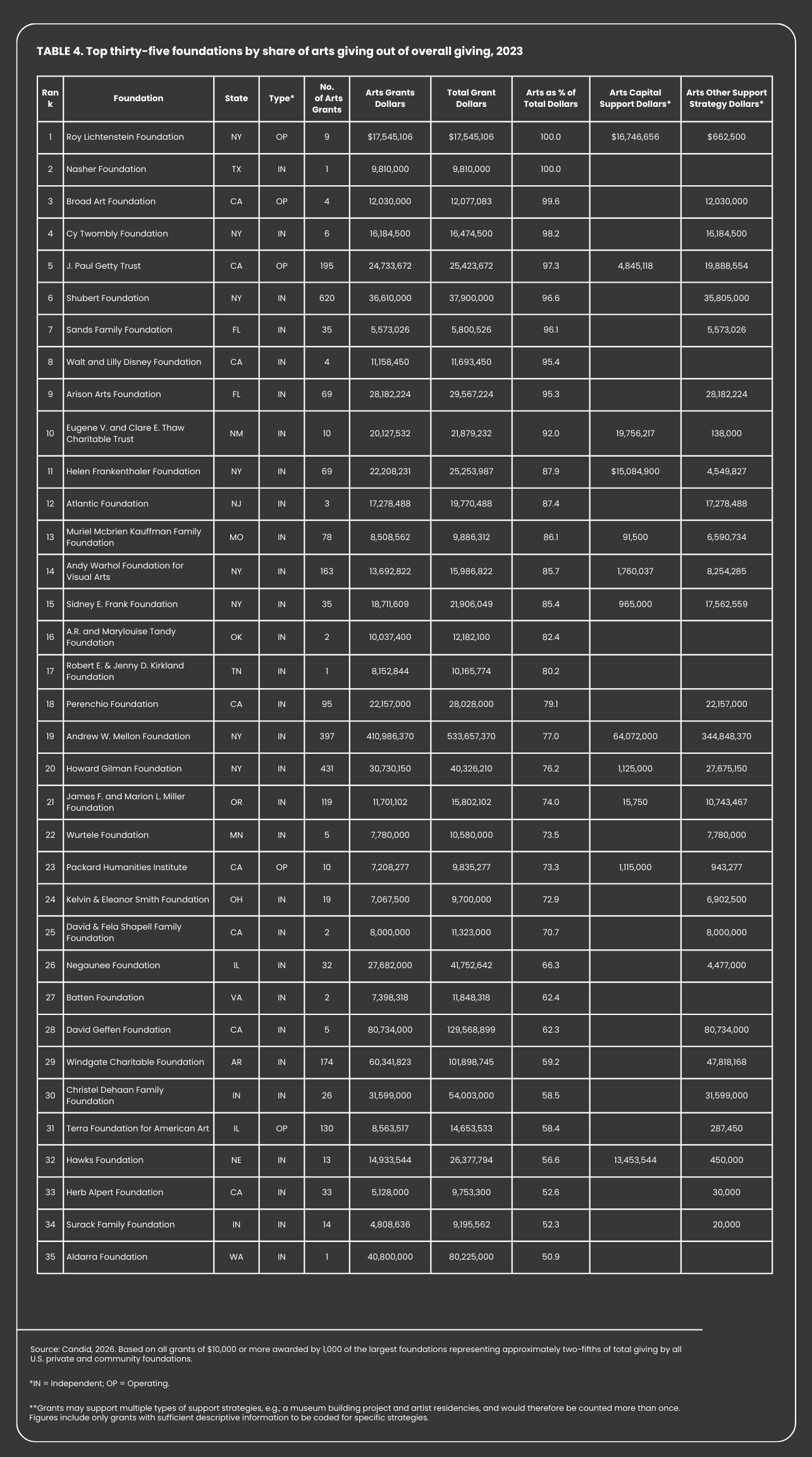
TABLE 4. Top thirty-five foundations by share of arts giving out of overall giving, 2023
Giving for International Cultural Exchange.
Grant dollars supporting international cultural exchange doubled between 2022 and 2023 among a matched subset of funders, following double-digit annual declines between 2020 and 2022. The number of grants they awarded also increased by close to two-fifths (38%). In 2023, foundations awarded 106 grants related to international cultural exchange totaling $18.1 million. The largest grant was a $2.3 million general support award from the Foundation to Promote Open Society to the Asia Society.
NOTES
[1] See Giving USA 2025: The Annual Report on Philanthropy for the Year 2024.
[2] Candid’s 2023 Foundation 1000 dataset includes all grants of $10,000 or more reported by 1,000 of the largest U.S. independent and family, corporate, community, and grantmaking operating foundations by total giving. For community foundations, the set includes only discretionary grants and donor-advised grants (when provided by the funder). The set excludes grants to individuals. It accounts for approximately two-fifths of giving by all active U.S.-based private and community foundations. Grant amounts may represent the full authorized amount of the grant or the amount paid in that year, depending on the information made available by each foundation. In addition, the Foundation 1000 includes giving between foundations included in the data set, which likely results in some amount of double-counting of grant dollars awarded.
[3] Each year, the set of funders included in the Foundation 1000 changes modestly, which could distort year-to-year fluctuations in funding targeting specific issue areas. To account for these potential distortions, the analysis examines changes in giving based on a subset of 859 funders for which the Foundation 1000 includes both 2022 and 2023 data.
[4] The median—meaning that half of the grants are above and half are below the amount—is generally acknowledged to be a more representative measure of the typical grant than the mean or “average,” because the median is not influenced by extreme high and low amounts.
[5] Beginning with the 2023 Foundation 1000 dataset, Candid changed how it identifies grants based on support strategy, resulting in a marked increase in the share of grants included in the “Not Specified” category. Among specific types of support strategies, this has primarily impacted the share of grants identified as supporting Program Development.
[6] Prior to 2015, the median amount had remained consistent at $25,000 since the early 1990s.
ABOUT THE AUTHOR
Steven Lawrence is an independent consultant who partners with foundations and philanthropy-serving organizations to document critical trends in the field. Among many reports he has authored in collaboration with GIA are Arts Funding at Twenty-Five: What Data and Analysis Continue to Tell Funders About the Field and Recalculating the Formula for Success: Public Arts Funders and United Arts Funds Reshape Strategies for the Twenty-First Century.