Disability Accessibility at GIA’s National Conference
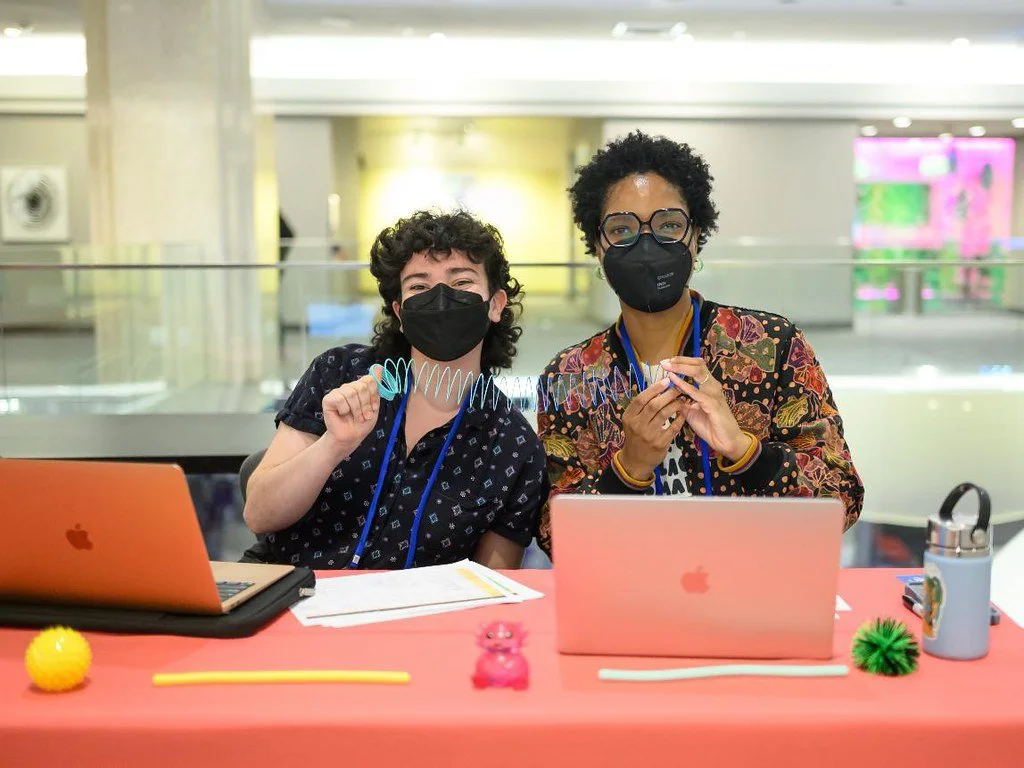
Accessibility consultants Lily Lipman and Jeanine Pollard at GIACON25 in Minnesota.
Photo credit: Jaida Grey Eagle
Grantmakers in the Arts (GIA) is a learning organization. That means we are responsible not only for what we are learning, but for how we share our learning with our field. Over the past several years, GIA has been deepening our understanding of disability accessibility as an essential part of equity-centered convening. There are great resources at our disposal which we are eager to share. We are grateful to the disability justice advocates, access workers, organizers, and field partners whose work continues to shape our practice, including Disability & Philanthropy Forum and their Disability Inclusion Pledge, which have offered important leadership and inspiration.
This work has also grown from within GIA’s own practice. When the COVID-19 pandemic moved our standard practice of gathering in person to online spaces in 2020, the GIA team had to learn quickly how access, participation, care, pacing, and public health shape people’s ability to be present. Since then, GIA has spent significant time learning from advocates and social justice organizers about disability access, online and in-person gathering, COVID-conscious practice, and what it takes to move from intention to implementation. The GIA team committed to this continued learning, recognizing that additional support and expertise is necessary to bring our efforts into closer alignment with our values.
At GIA’s 2025 National Conference in Minnesota, we hired accessibility consultants Lily Lipman, Jeanine Pollard and Scott Artley, who offered a mix of national, regional, and local context as part of the planning team, to support a more accessible conference experience. Some of this work was visible to attendees: An accessibility help desk across from registration; Tablets for personalized CART captioning in breakout sessions; Microphones and sound amplification; Reserved seating upon request; A nursing room and prayer space; A low-stimulation space; A COVID-conscious, air-filtered, socially distanced dining space; Meeting layouts designed with clear pathways for people using wheelchairs, scooters, and other mobility devices.
Conference participants could also request accessible transportation, mobility scooters, ASL or Spanish interpretation, and other accommodations. Attendees with mobility access needs were supported in navigating off-site venues, with accessibility consultants accompanying them, troubleshooting in real time, and advocating alongside them when a space required additional attention or adaptation.

Art by: Nanda Mentesheva for Fine Acts
What was less visible, but just as important, was the process and labor required to make those supports possible.
Accessibility did not begin when attendees arrived at registration. It began months earlier, with planning, site visits, design decisions, communication, and coordination across many moving parts. GIA’s accessibility consultants joined staff for advance site visits to conference venues to assess whether accessibility standards were being met and to identify where improvements could be made. That included reviewing entrances, routes, room layouts, restroom access, elevators and ramps, door widths, table spacing, low-stimulation spaces, drop-off points, and the pathways attendees would need to navigate throughout the conference.
The consultants also offered specific recommendations for improvement wherever possible. This included attention to gender-inclusive bathrooms, low-stimulation spaces at multiple venues, clearer mobility routes, scent-free considerations, space for wheelchair and scooter passage, and the practical details that determine whether a venue is accessible in lived experience, not only on paper.
There was also significant labor behind the conference website and advance communications. GIA worked to make clearer what attendees could expect before they arrived, how to request support, and how to access accommodations during the conference. This included information about venue accessibility, accessible transportation, mobility devices, the use of iPads for personalized CART captioning, and how to contact the accessibility consultants with questions or concerns. When hotel and venue changes became necessary, staff and consultants also helped attendees navigate reservation changes and shifting logistics with access needs in mind.
Accessibility also shaped the design of conference materials themselves. GIA and the accessibility consultants reviewed the conference website, paying attention to issues such as font size, contrast, and clarity of information. They also coordinated with the audio-visual team for plenaries and sessions and supported accessible slide deck practices, recognizing that visual design choices can either support or limit participation. Presenters and facilitators were required to participate in training on accessible presentations and sessions, reinforcing that access is not only a logistical responsibility but a shared practice across the full conference program.
The consultants also helped GIA research, identify, hire, and coordinate Communication Access Realtime Translation (CART) providers. This included sharing conference content in advance so CART providers could prepare for the language, names, topics, and terminology used across sessions. GIA and the consultants also researched, secured, and provided mobility scooters for attendees who requested them.
2025 National Conference participants reflected the importance of this work in their feedback:
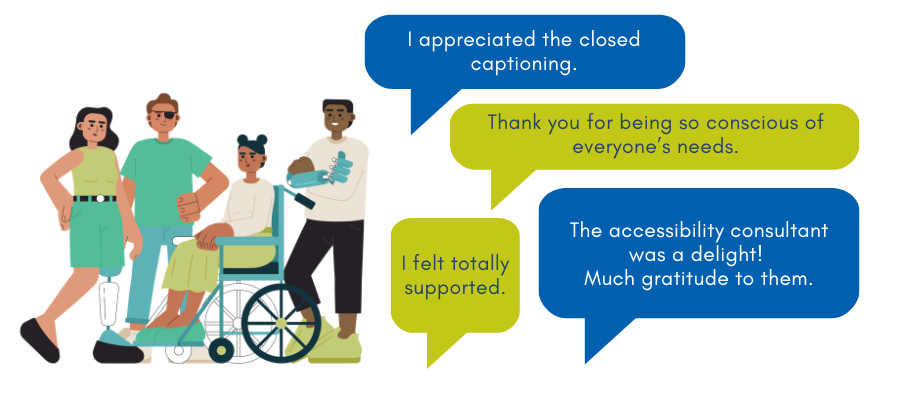
Reflections from 2025 National Conference participants on accessibility supports, speech bubbles capturing participant feedback including: I appreciated the closed captioning. Thank you for being so conscious of everyone’s needs. I felt totally supported. & The accessibility consultant was a delight! Much gratitude to them.
GIA’s and our consultants’ level of preparation matters because accessibility is always specific to place, context, and people. It is not enough to have a general commitment. Access has to be planned, tested, communicated, resourced, and adjusted in real time.
The required combination of preparation and flexibility became especially clear in 2025 when GIA left its originally contracted hotel in order to stand with workers during a labor dispute. That decision was aligned with GIA’s values. That decision it also meant that much of the accessibility planning had to begin again. Venue routes, room layouts, transportation plans, access information, and attendee communications all had to be reviewed and revised. In practice, this doubled parts of the preparation process and made the labor of access even more visible to those responsible for carrying it.
GIA’s 2026 National Conference in Memphis will be even more complex. The conference will take place across cultural sites throughout the city, rather than in a single hotel-based setting. This model creates powerful opportunities to learn from place, artists, organizers, and cultural communities. It also significantly increases the amount of accessibility planning required. Each site will need to be understood on its own terms, with attention to transportation, entrances, restrooms, pathways, low-stimulation options, seating, sound, signage, and the full experience of moving through the conference.
We believe this work is worth it. We also know that believing in its worth is not the same as doing it well. That is why GIA continues to invest in outside expertise, staff learning, clearer communications, and ongoing accountability. We are grateful for the partnership and learning offered in collaboration with the 2025 Accessibility Consultants. GIA continue to practice what we are learning with a commitment to maintaining this rigor throughout the year, not only during the conference.
All of this remains a learning process. We will not get everything right, and we know that good intentions do not guarantee access. But GIA are committed to continuing the work, asking better questions, resourcing the labor it requires, and sharing what we learn with the field.
Thank you for joining GIA on this commitment to learning and accountability to each other.
ABOUT THE AUTHOR
Eddie Torres is president & CEO of Grantmakers in the Arts